
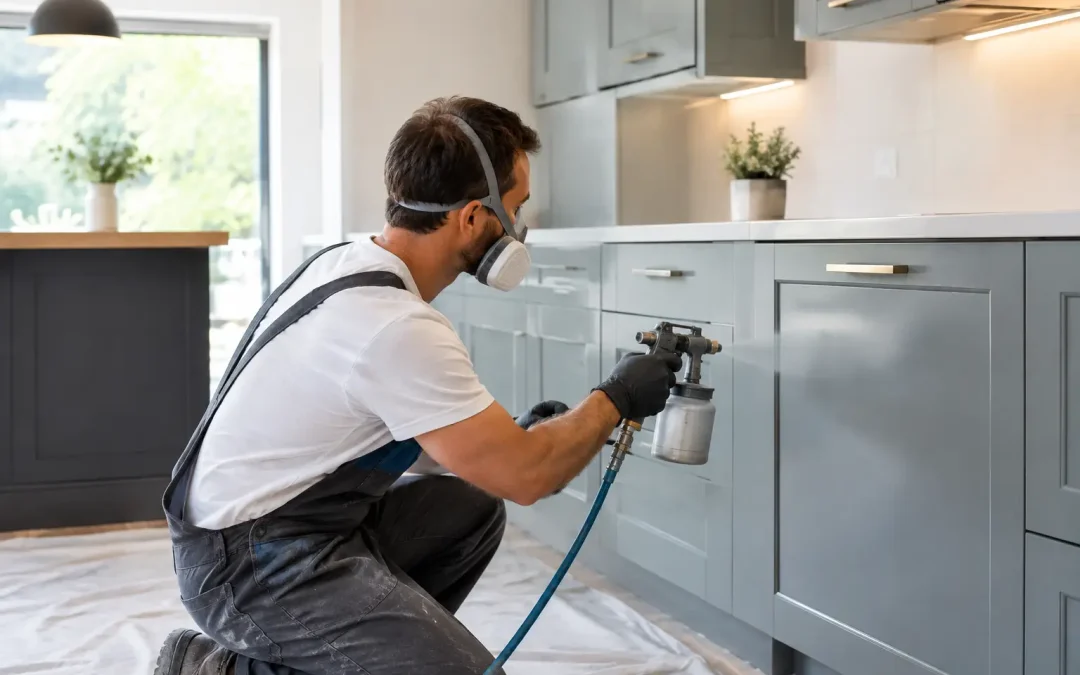
A dated kitchen does not always need to be stripped out and replaced. If the cabinet doors, drawers and carcasses are still sound, a professional kitchen respray can change the look of the room dramatically while avoiding the cost, waste and disruption of a full new installation.
For homeowners, landlords and property movers, it is often the practical middle ground. You keep the layout that works, retain good-quality units and choose a fresh colour and finish that suits the rest of the home. The result can feel like a new kitchen, without weeks of trades, missing worktops or living around a major refurbishment.
When is a kitchen respray the right choice?
A respray works best when the underlying kitchen is in good condition. Cabinet doors should open and close properly, hinges should be serviceable, and the units themselves should be free from serious water damage or swelling. Solid wood, MDF, laminate and previously painted doors can often be prepared and sprayed successfully, although the exact method depends on the material and its current condition.
This makes respraying particularly useful for kitchens that look tired rather than worn out. Perhaps high-gloss cream doors have yellowed, oak-effect cabinets feel dated, or a previous paint finish is chipped and uneven. Changing the colour can bring the room in line with new flooring, worktops, wall colours or handles without changing everything else.
It is not always the answer. If units are badly damaged, doors are delaminating, cabinets have been affected by a leak, or the layout simply no longer meets your needs, replacement may be the better long-term investment. A straightforward assessment before work begins helps avoid spending money on a finish that cannot perform as it should.
What a professional kitchen respray involves
The smooth finish people associate with sprayed kitchens is not achieved by simply applying paint to the doors. Preparation is where much of the quality and durability comes from.
First, doors, drawer fronts, handles and removable fittings are taken off where appropriate. This allows the work to be carried out carefully around edges, profiles and recessed areas, rather than leaving brush marks or missed sections. Surfaces are then cleaned thoroughly to remove grease, cooking residue, polish and everyday grime. Even a kitchen that appears clean can have a film on it that affects adhesion.
After cleaning, the existing finish is keyed and any chips, dents or minor imperfections are filled and sanded. The correct primer is then used for the surface. This is especially important with laminate, vinyl-wrapped or glossy doors, where ordinary household paint is unlikely to bond reliably.
Once primed, the doors receive trade-grade spray coatings in controlled, even layers. Advanced spray application produces a consistent finish across broad flat panels as well as moulded details. Between coats, surfaces may be lightly denibbed to remove tiny imperfections and help create that refined, furniture-style appearance.
The final stage is reassembly and checking. Doors need to be refitted neatly, handles aligned and moving parts tested. A quality job should look considered from every angle, including door edges, corners and the visible frames around the cabinets.
Why spraying usually looks better than painting by hand
There is nothing wrong with hand painting in the right setting, but kitchen cabinets are demanding surfaces. They are touched constantly, exposed to steam and grease, and often have wide flat areas where roller texture and brush lines are easy to spot in daylight.
Spraying applies the coating in a fine, even mist, helping it level out for a smoother finish. It is particularly effective on slab doors, shaker-style doors and detailed mouldings, where a uniform appearance can be difficult to achieve with a brush alone. The aim is not merely a new colour, but a finish that looks properly renewed rather than quickly covered.
Durability also depends on the paint system, curing time and surface preparation. A professionally sprayed kitchen should be designed for normal daily use, but it still needs sensible care. Slamming doors, scouring pads and harsh chemicals will shorten the life of any painted surface. A soft cloth and mild cleaner are usually all that is needed for routine cleaning.
Choosing colours and finishes for your kitchen
A kitchen respray gives more flexibility than many people expect. Soft whites, warm greys, sage greens, deep blues and charcoal tones remain popular because they work well with a range of worktops and wall finishes. However, the best choice depends on the light in the room and the style of the property.
In a smaller or north-facing kitchen, pale warm shades can help the room feel brighter without looking stark. Larger kitchens can often carry darker colours well, especially when balanced with lighter worktops, splashbacks or walls. A two-tone approach can work too, with darker base units and lighter wall cabinets creating contrast without making the space feel heavy.
Sheen level matters as much as colour. A matt or low-sheen finish gives a contemporary, understated look and can hide minor surface variation well. Satin offers a subtle soft sheen that is practical and popular for cabinetry. Higher-gloss finishes reflect more light, but they can also show fingerprints and require particularly careful preparation.
Before committing, consider the worktop, tiles, flooring, appliances and handles as one scheme. Replacing handles at the same time is a small change that can make resprayed units feel even more complete. It is also worth testing colour samples in the actual kitchen, as natural light and artificial lighting can shift the appearance significantly.
How long does the work take?
Timescales vary with the size of the kitchen, the number of doors and drawers, their condition, and whether frames, end panels or other timberwork are included. A small, straightforward kitchen can often be completed far more quickly than a replacement project, while a large kitchen with extensive repair work will naturally take longer.
The biggest benefit is reduced disruption. In many cases, the cabinet carcasses, worktops and appliances can remain in place. Careful masking and tidy working practices protect surrounding surfaces while the work is carried out. Some components may need to be sprayed away from the kitchen for the best controlled finish, so there can be a short period when doors are removed.
Allowing coatings to cure properly is part of a professional process. It can be tempting to rush reassembly or return to heavy use immediately, but giving the finish appropriate time to harden helps it stand up to day-to-day life.
Cost, value and the questions worth asking
The cost of a kitchen respray depends on the number and type of units, their condition, the chosen finish and the level of preparation required. It will generally cost less than replacing a kitchen, particularly when existing worktops, plumbing and appliances can stay where they are. But it should not be treated as a shortcut based on price alone.
A low quote can leave out essential preparation, suitable primers, protection for surrounding areas or proper finishing work. Ask what surfaces are included, whether both sides and edges of doors will be sprayed, how damage will be repaired, what paint system will be used and how the kitchen will be protected during the work.
It is also sensible to choose a fully insured decorator with experience in spray application, rather than relying on a general paint service that treats cabinet doors like walls. The difference is visible in the finish, but it also affects how well the surface lasts.
For properties across Milton Keynes and the surrounding area, RS Interiors MK provides tailored kitchen cabinet makeovers using careful preparation, premium materials and professional spray equipment. A clear, no-obligation quotation means you can decide whether respraying is the right fit before any work begins.
If your kitchen layout still works and the units have plenty of life left, do not assume replacement is the only way forward. A well-planned respray can give the room a clean, durable new look while keeping the project manageable, practical and personal to your home.
Recent Comments